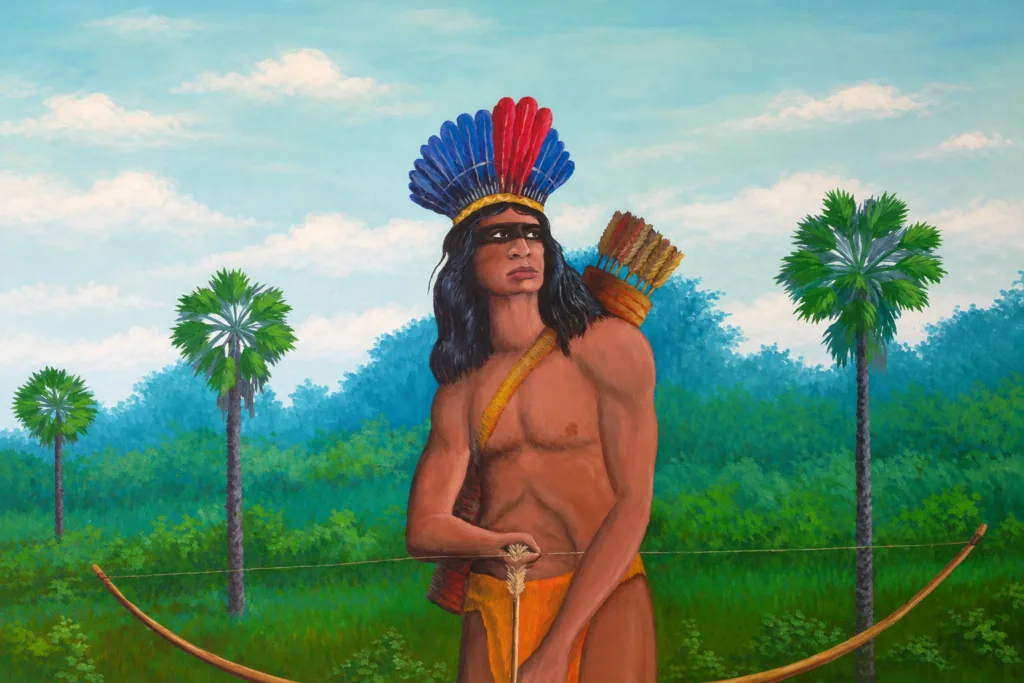
Although banished from many official documents and treated as a second-class citizen, misunderstood by the European standards of his time, the Indigenous leader Mandu Ladino was real: he existed and is recorded in several old documents. Today his love for the “Sertões de Dentro” (the Inner Backlands, as Piauí was then known) stands out more than ever. From 1712 to 1719 he waged several struggles to drive out the Europeans who arrived to set up cattle ranches.
Who was Mandu
Mandu Ladino was probably born around 1689 in an Indigenous village in Piauí, between the present-day towns of Campo Maior (formerly Bitorocara) and Castelo do Piauí (formerly Marvão).
When he was 8 years old, in 1697, his village was attacked and everyone was killed except the little boy, whom the Portuguese named Manuel.
Manuel was handed over to the Jesuits, who raised him in a monastery in Paraíba. At 17 he fled the monastery and returned to Piauí. Catechized, familiar with Christian teachings and fluent in Portuguese, he gathered scattered Indigenous people he met along the way back across northeastern Brazil.
From then on he began uniting other tribes still living in Piauí, convincing them of the need to fight the ranchers who were settling there.
Leading the first attack on a ranch with flaming arrows, he burned down several ranches. Since his name was Manuel, he became known as Mandu and later as Mandu Ladino — “ladino” meaning cunning and quick, someone who did not surrender easily.
From 1712 to 1719 he waged several wars against the bandeirantes and the Portuguese who were settling Piauí’s lands. In retaliation, the Indigenous fighters were attacked with firearms and, often caught by surprise, lost battles. Mandu’s cunning and strategy nevertheless won them several battles, fought in the central part of what is now the State of Piauí.
Around 1718, greatly weakened, Mandu and his band crossed the Serra da Cangalha, where the town of Pedro II stands today, to seek help from the Tabajaras, an anthropophagous people living in the Serra da Ibiapaba. This tribe was feared even by Mandu’s own people, as they displayed the heads of enemies defeated in war on wooden stakes.
On reaching the tribe, where the town of Viçosa stands today, Mandu realized that the Tabajaras had been catechized by the Jesuits, who were spreading Christian teachings throughout the Serra da Ibiapaba.
Convinced that the Tabajaras were no longer warriors, Mandu returned to Piauí and lost his last battle, with his warriors old, exhausted and heavily outnumbered.
His body was buried on a “hill called Ladino, surrounded by caves with Indigenous inscriptions,” as was once believed, near where the town of Alto Longá, Piauí, stands today.
To prevent pilgrimages to his grave, the ranching elite spread the story that Mandu had died in the Igarassu River in Parnaíba, a branch of the old Rio Grande dos Tapuias (today the Parnaíba River), so that everyone would believe his body had drifted out to sea — preventing pilgrimages and the preservation of his memory.
A hero of resistance
Orphaned after his tribe was attacked by the Portuguese, Mandu was handed over to and educated by Jesuits in Paraíba (or perhaps Pernambuco) from age 6 to 17, when he fled back to Piauí. Familiar with religion, Christianity and European social customs, he served as an important translator between Tupi and Portuguese. His route back from Paraíba to Piauí has become a trail of great social and cultural interest.
Despite winning several battles, Mandu heroically lost the war against the Europeans. Had he succeeded, we would have had the world’s first independent Indigenous nation. For Indigenous peoples and for contemporary Brazilian culture, Mandu is what Zumbi represents for Black Brazilians.
For Indigenous peoples and for contemporary Brazilian culture, Mandu is what Zumbi represents for Black Brazilians.
Through Brigada Mandu Ladino, the history of this remarkable Brazilian — a key figure in the largest ethnocide in the Americas — is being recovered. Piauí is the only Brazilian state without an Indigenous population.
To keep his ideas alive, and in gratitude for his struggle, Brigada Mandu Ladino is organizing the construction of a monument to his glorious history.